

Features, Politics, Social Justice
How ‘War’ in American Media Normalizes Atrocity
Journalistic framing has historically shaped public perception. Whether implicit or explicit, word choice shapes how people receive information. Certain words or phrases are strategically used to evoke specific emotions in readers. “War” is a loaded word. In American media, journalism, and politics, people seldom use it to describe an actual war. Often, “war” is a word used to demonize a certain demographic of people. We witnessed this in the 2003 Invasion of Iraq, dubbed the “war on Iraq,” and the failed “war on drugs.” Neither was actually a war—they were branded as such to evoke fear.
Through this carefully constructed fear-mongering, those in power can get away with heinous acts they otherwise could not carry out. The current “war with Iran” is a product of years of media biases surrounding the Global South. We’re watching the same story play out. The reality is this: under the guise of so-called war, the United States of America can get away with pretty much anything. It just needs the right PR.
The ‘War on Drugs’
“War” has often been justified in the name of religion. However, underneath this sheath of piety lies the ugly head of racism and general prejudice. When the Nixon “war on drugs” began in 1971, it was disguised under “Christian repudiation of shamanic ecstasy, which it labeled devil worship or witchcraft.” This “war” relied heavily on the reinforcement of beliefs surrounding drugs being inherently bad. “Just Say No” became the phrase of the century when Nixon’s campaign to eradicate illegal drugs came to fruition. In a now infamous “Just Say No” campaign broadcast on CNN, Nancy Reagan warns against “drug criminals,” and describes “how terrible and threatening drug abuse is to our society.”
There is no explicit mention of religion and no equation of drugs to unholiness. That is, until the very last moments of the segment. After speaking on how Americans must do everything they can to protect the “sons and daughters of the United States,” she then subtly slides religion into her “Just Say No” campaign. Reagan states that the youth of America should “open [their] eyes to life—to see it in the vivid colors that God gave us as a precious gift to His children.” At a glance, this is not profound or even mention-worthy. In a broader context, though, this perfectly encapsulates how the Nixon and Reagan administrations managed to pioneer the most devastating bout of mass incarceration that continues to have lasting effects to this day.
The Lasting Effects of the ‘Just Say No’ Campaign
In equating the youth of America with God’s children, Nancy Reagan’s statement gave a green light to an infestation of discrimination. This was the First Lady’s endorsement of racism and xenophobia. In saying that “drug criminals are ingenious,” and that they “work every day to plot a new and better way to steal our children’s lives,” she planted the idea that immigrants and people of color in the US were the root of all evil– that their one goal in life was to corrupt the lives of good, Christian, American children.
This had lasting destructive effects on the US population, primarily in minority communities. In 2013 alone, there were 1.5 million drug arrests in the US, of which 80% were for possession alone. These are jarring numbers already, but when we take racial statistics into account, it becomes even more apparent that Nixon’s “war on drugs” was built on racism. While black people only make up roughly 13% of the US population, they account for “30 percent of those arrested for drug law violations—and nearly 40 percent of those incarcerated in state or federal prison for drug law violations.” Simply put, the ‘war on drugs’ was a shield for racism. And it worked.
The ‘War on Terror’
While the ‘war on drugs’ may not have been successful in eradicating drug addiction, it was successful in perpetuating systemic racism toward Latinos, Black people, Chinese Americans, and eventually extended to basically anyone who does not have the complexion of milk. This did include Arabs, but the “war on terror” is what truly targeted brown people in the U.S. Post 9/11, there was no longer just the fear of ambiguous “drug criminals.” There was now a clear and American-backed reason to fear brown people. This was not only dubbed an American issue—rather, it was also referred to as the “Global War on Terrorism.“ Much of the headlines surrounding the “global war on terrorism” often contained various Arab and South Asian countries alongside the word “terrorism,” directly correlating brown people with terrorism in viewers’ minds.
In a 2012 timeline detailing coverage on the “war on terror,” published by PBS, the headline reads “Iraq, Afghanistan and The War on Terror.” This, in itself, immediately frames terrorism as a SWANA issue. This phenomenon spread into dozens of trusted newsrooms. Coverage of the “war on terror” heavily enforced linking terrorism between Arab and South Asian nations. There were often headlines questioning whether other Arab nations were involved in the 9/11 attacks, such as CNN’s piece on whether Iraq was involved with U.S. military presence in Afghanistan. It allowed racism to stay prevalent. And much like the “war on drugs,” it had devastating effects on the Arab world. “Arab” became synonymous with “terrorist.” “Muslim” became synonymous with “extremist.”
Modern Coverage of Israel and Palestine
This phenomenon carries over into the coverage of the Israeli occupation of Palestine. Western media tends to take much more neutral tones when describing the deaths of brown people. This is partly because coverage of the “war on terror” shaped it. Similarly to how American soldiers were “murdered and mutilated” in Iraq while Iraqis were simply “dead,” Israeli settlers have been “killed,” while Palestinians are referred to in terms of a vague “death toll.” Even in articles that attempt to vouch for Palestinians, the tone is still incredibly passive.
For example, Time Magazine’s “The Science Is Clear. Over 30,000 People Have Died in Gaza” aims to humanize Palestinians at a surface level. However, the first line of the article is “The first shock was the number of people killed in Israel—1,200 in a day, Oct. 7.” Even in articles attempting to throw Palestinians a minuscule amount of humanity, Western bias is abundantly clear. Western coverage of the Palestinian genocide typically follows the same model. Palestinians have died, which is sad, but Hamas killed 1,200 people on October 7th, which is even sadder because they didn’t just miraculously die like the Arabs tend to do. Despite this feeble attempt to seem more objective and less blatantly racist, the verbiage reinforces a clear notion—Arab lives are simply not as important as American lives.
Along with this, the “war on terror” largely links Arab-led attacks to terrorism or Islamic extremism. A prominent example of this is the coverage of the 2016 Pulse nightclub shooting as opposed to other mass shootings. In 2016, CNN offered a list of names of the deceased and titled it “Terror in Orlando.” On the other hand, when a white gunman stormed Marjory Stoneman Douglas High School in 2018, there were no mentions of extremism or terrorism. The shooter, Nikolas Cruz, was repeatedly dubbed a “teen gunman.” Also, many articles reference how the attacker was “lonely” and “ostracized.” While both “gunman” and “terrorist” are negative descriptions, one carries a much more racially motivated connotation than the other—a prevalent trope in Western journalism.
Manufacturing Consent for War With Iran
This leads us to the current war with Iran and its implications for the entire SWANA region in the name of spreading American freedom and democracy. If we set our critical thinking and pattern recognition skills aside, the first clue that this latest bout of U.S. intervention in the SWANA region is not truly about freeing its people from—you guessed it—terrorism lies in how our administration has conducted itself.
On April 7, 2026, President Donald Trump stated that “a whole civilization will die tonight, never to be brought back again.” This targeted Iran ahead of a deadline for a diplomatic deal. “A whole civilization will die tonight.” And we’re meant to believe that this is in the name of freeing said civilization? What’s truly infuriating, though, is that there is absolutely nothing new about this playbook. We’re watching it be used over and over again. It’s the same threat of terror spreading and imaginary weapons of mass destruction repackaged in a new never-ending “war.” The only difference is that Trump is just more obnoxious about notifying us that he’s going to bomb people.
Journalistic framing can change narratives—because journalism is the narrative. Objectivity in journalism is impossible. Objectivity is arguably unattainable in general. As long as human beings are behind the narrative, true objectivity will never exist. Facts might be true, but how people frame them absolutely changes how people receive them. This has become apparent through the coverage of the 9/11 attacks, the “war on drugs,” the “war on terrorism” and more recently the “Israel-Hamas war.” In three letters, Western journalism has managed to facilitate murder, mass incarceration, and genocide. “War” is a loaded word, and it’s entirely foolish to label anything dubbed “anti-American” as a “war.”
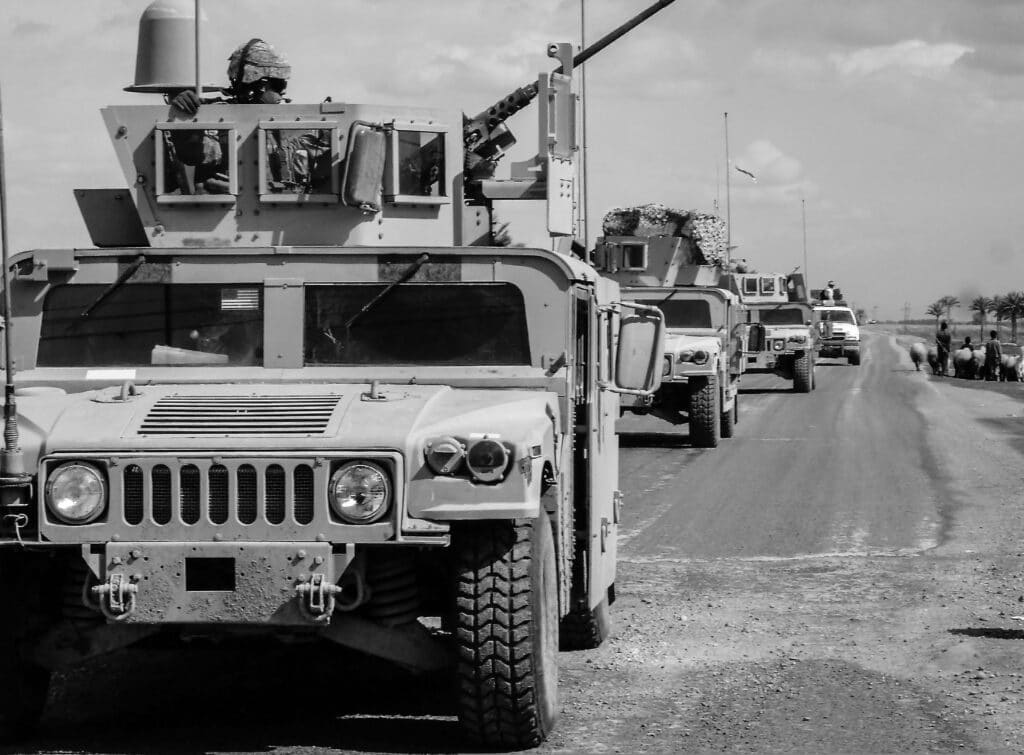
Featured image credit: Mike Cook / Pixabay