

Commentary, Features, Politics, Social Justice
Palestinian ‘Qahr’ Explained Through Text Messages
‘Are You Okay?’
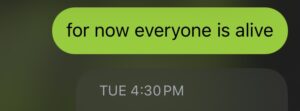
A text message that I’ve found myself sending far too often within the past week is, “Are you okay?” It’s a uniquely nauseating feeling to be unsure whether your family and friends are alive at this moment. To wonder if they’ve been erased from existence, as my ancestors were in Palestine. To be unaware whether the building that you spent your summers laughing and eating kibbeh and gossiping with your aunties is reduced to rubble or not is a difficult feeling to describe. Not knowing whether my childhood home has been destroyed for simply existing in the wrong place at the wrong time feels like I’m watching my memories be wiped away before my eyes. It’s sadness, of course, and a grief that always circles back to indescribable rage that this is my family’s reality.
2026 Context
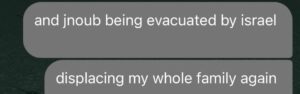
On March 1st, 2026, the Israeli army issued evacuation orders for 53 cities in South Lebanon, displacing nearly 700,000 people from their homes. If you’re Arab, you know that an “evacuation order” from the IOF essentially means “we’re going to bomb you no matter what, so either leave or die.” This is a familiar feeling for any Palestinian, reminiscent of the 1948 Nakba. My family was forced out of Akka, Palestine, in 1948 and eventually found refuge in Saida, Lebanon. This is not a unique story, though. Ask any Palestinian, and they will tell you the same tale of mass expulsion. As everyone was preparing to be violently displaced again, Israel bombed Saida with no warning. My beautiful Saida, where I often watched the sunset from my grandmother’s balcony as a child, was reduced to an unfortunate casualty of war.
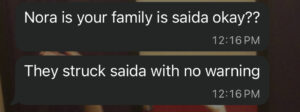
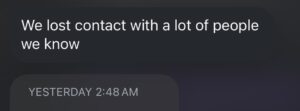
Following the evacuation order and subsequent bombing, I found myself asking many questions with no answers. What gives a colonial presence the jurisdiction to displace over half a million people in an entirely different country? What precedent is there to bomb residential buildings, schools or refugee camps? Is my 75-year-old aunt also a militant? What about my 10-year-old cousin? Is the building that my family has called home for generations also considered a military target? Will I be able to contact them tomorrow? Will they choose displacement or remain steadfast on our land? Will I ever be able to return to my homeland?
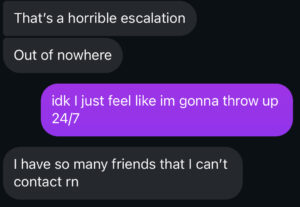
These generationally unanswered questions bring me back to the rage that I and millions of others have felt for our whole lives. A rage so indescribable that we had to designate a word for it: qahr.
Qahr
Qahr is a word with no equivalent in English. The closest translation that I can give is a deep-rooted, indescribable, generational rage blended with profound sadness and grief.
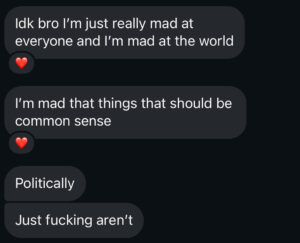
The first time I remember feeling qahr was when I was 5 years old. Gaza was under fire in 2008, and I encountered the claim of “human shields,” used by resistance fighters. Being that I was barely sentient, I had no concept of propaganda. I believed that the resistance was truly utilizing human shields. So, I took to activism on the playground and convinced my friends that if Palestinians needed human shields, we should act accordingly. I was ready to martyr myself because if that’s what my people needed, so be it. Obviously, this logic was flawed, and I didn’t realize that at the time.
Nevertheless, I was still very upset when my uncles and aunts laughed in my face as I attempted to recruit them for my cause. There are times when I find this story humorous: a little girl who thought she could change the world on the front lines. Then I remember that little girl and feel the qahr that I felt as a child. And, suddenly, I’m angry for that little girl. I’m angry that she was desensitized to gore by the time she turned 6; angry that she knew what white phosphorus was and what it does to the human body; angry that she was already jaded and hated the United Nations by the time she was in kindergarten.
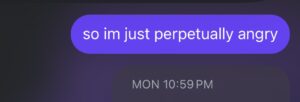
Then, I take that anger and imagine what it must feel like to live in Palestine. I’m met with a profound numbness when I put that into perspective. If I’m feeling this angry and I’ve felt this qahr for my whole life, what must Palestinians in Gaza feel? How must my family in Saida feel knowing that they’re likely going to experience what our collective nightmare has been since 1948?
Pieces of Our Homeland
This sort of generational trauma doesn’t go away once the leaders shake hands and the bombs stop falling. You can’t undo decades of bombardment.
As I sit writing this article with Fairuz playing in the background, it feels like the world is leaving me behind. I’m listening to a record my cousin gifted me, watching missiles fall on a low-quality video call through a record player my grandfather gave me. He was the last family member in my bloodline who saw our tobacco farms in Palestine. I’m wearing a necklace given to me by my grandmother, who was forced to flee Lebanon during the civil war.
My father is downstairs listening to Al Jazeera and, whether he would like to admit it or not, he is overcome by qahr. There are relics of my homeland sewn throughout every avenue of my being, yet I still feel as though it’s being erased bit by bit. I’m frozen and can’t understand how everyone is just going about their lives like nothing is happening. This is what it means to feel qahr.
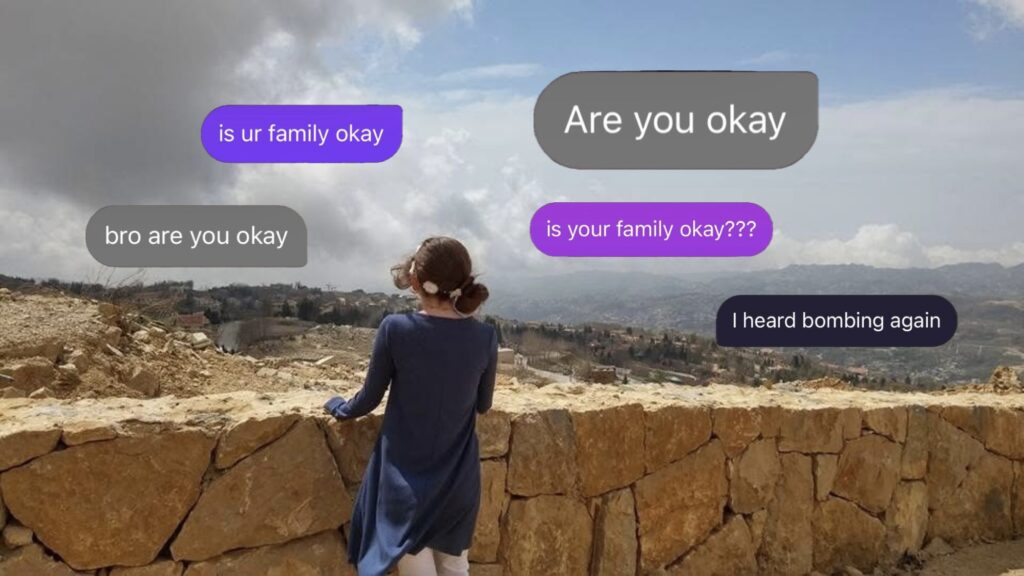
Featured image credit: Faraya, Lebanon 2016 / Nora Grace Khatib

Thank you for telling the story about a part of our multigenerational trauma our disgust with how a world not only ignores but in many cases funds its continuation