

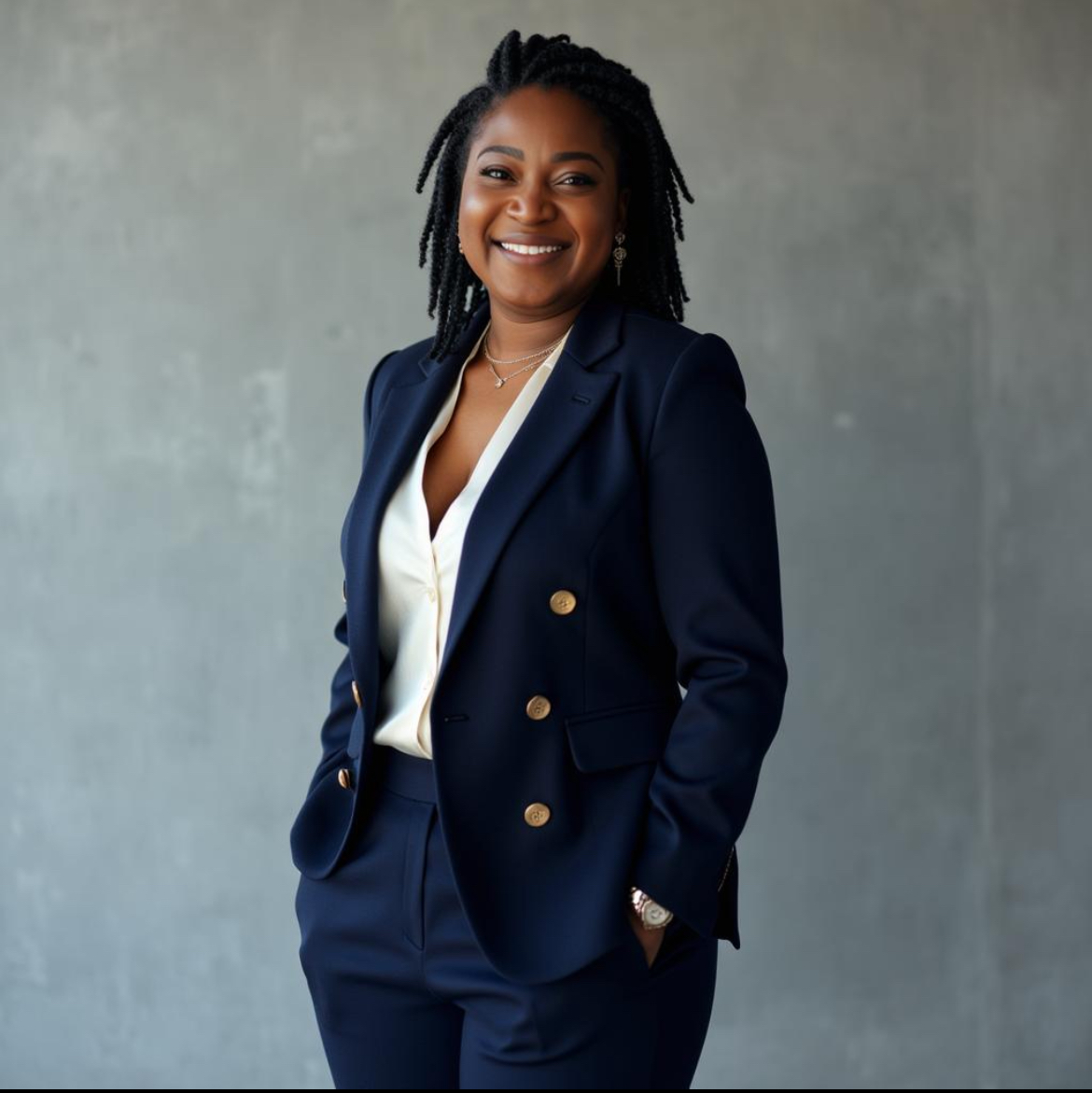
Utah isn’t where most people expect to find a thriving Black Street festival. But thanks to Michelda G. Castro, that’s exactly what Utah residents have come to experience.
I had the chance to chat with the powerhouse organizer behind Utah’s premier Black cultural celebration — The Unity Block Party, returning to Salt Lake City this August 29–31.
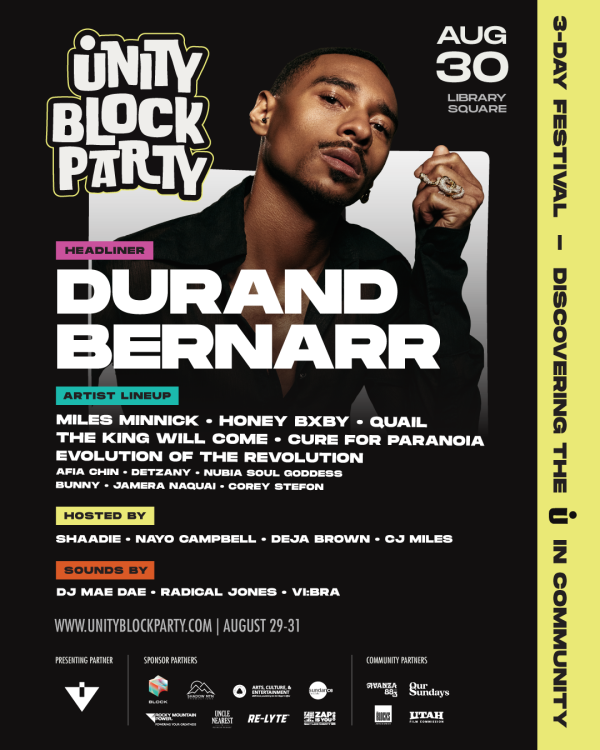
But wait, there’s more: Grammy-nominated artist Durand Bernarr also entered the chat.
Stop me if you’ve heard this one before: a Grammy-nominated artist — whose NPR Tiny Desk performance made everyone else bring their A-game and a master organizer walk into Utah…
Together, they bring a three-day event that’s making major waves, delivering Black excellence to a region where cultural representation is long overdue. From a Sundance-supported film screening to performances by Honey Bxby, Miles Minnick, and more — culminating in the Black Creative Excellence Brunch — this is more than a festival. It’s a movement.
The Unity Block Party amplifies Black arts, economic empowerment, and community impact during Black Business Month. In this conversation, headliner Durand Bernarr and Michelda G. Castro open up about this year’s celebration, which promises to be bigger, bolder, and more impactful than ever.
Q&A
Dion Ringgold: Michelda, what was the defining moment — the conversation, the image, the nudge — that made you say, I have to do this?
Michelda G. Castro: I had just moved to Utah from South Florida. I’m originally from Fort Lauderdale, Florida. My parents migrated from Haiti in 1979, so I’m first-generation Haitian American, and I moved to Utah out of pure inspiration by the one I follow — Jesus Christ. And so, I was like, “Utah? Ain’t even no Black culture.”
My brother lived here, and I was visiting him when he first had his first baby. I was just like, there’s not enough Black culture here for me, but I was alright. The Lord said, “We gonna go.” I said, “Alright, I’mma pack up my stuff and go and be obedient.”
I was pursuing my career in wealth management at Wells Fargo, and it was post–George Floyd, and I was just heartbroken. I think for most people in the world who has a soul or have a human bone in their body, that moment shifted them mentally and emotionally. I was just sad. I wanted to do something.
I was strolling on Instagram one day and saw this traveling memorial that started in Portland, Oregon, and something said, “You need to do this here in Utah.” And I was like, okay, probably one of the oddest places, because we make up less than 2% of the population here. It’s predominantly white. It’s also a very red state. Slavery was still legal up until probably two years ago.
There were a lot of reasons to want to do something like this, but my soul was just broken, and I just wanted to feel some type of joy. And I was like, “Yeah, I’m gonna do this here in Utah.” They sent me the information. It started off as the “Say Their Names” Memorial, and I kind of 10x’d it because I can’t do anything small.
We turned it into a block party. I literally blocked off a road outside my apartment. Asked my apartment complex, “Hey, can we use this fence?” And we got some vendors, food trucks, a DJ — and it was magical. Seeing everybody dancing in the street, from children to older people.
A lot of Black businesses didn’t have a lot of opportunities to make money, especially because COVID hit right after that. Even giving them an opportunity to make a few coins to keep their economy moving forward — it felt like the right thing to do. So that’s how it started.
DR: That’s incredible. Given the timing, was there resistance or hesitation?
MC: Not initially, because I knew where I was moving. I was fully aware it was Utah. I had to be intentional about getting into Black spaces. I was the only Black person I saw — and that was me looking at myself in the mirror before work most days.
It was a culture shock, not seeing people that look like you on a consistent basis. I took Fort Lauderdale for granted. I was used to walking outside and seeing my people.
It didn’t hit me until news and press started picking up our story. They came, covered it, and then you see the things online — a lot of negative posts. But the community I curated it for appreciated it. Especially the Black-owned businesses and food trucks. They were wondering, “When’s the next one?” They felt like they were transported to another place. It didn’t even feel like Utah.
That’s the power of Black culture I get to experience as a first-generation Haitian American. I’m not a descendant of chattel slavery — Haiti had its own revolution — but being a Black American in America is something different. Experiencing Black culture in South Florida made me grateful I could curate a space that felt welcoming here.
We started shifting our thinking about connecting the African diaspora all across the world. For those I curated it for, there was no opposition. For those who don’t understand or want to be ignorant to why we carve out Black spaces, they didn’t take it so well.
DR: You’ve called the event a love letter to the community.
MC: That was the purpose. I wanted my people to feel loved and seen and taken care of. It’s hard doing anything in America as a Black person.
Most spaces I go into are white male–dominated. Being surrounded by that all the time, I wanted to be intentional. I think about what I do. I pray about it. Before anything, I’m a child of God, and one of my main purposes is to spread love as much as I can. This is my love letter to the Black community.
DR: Durand, what was the moment you knew you needed to be part of this?
Durand Bernarr: First and foremost, I’m all about what’s For Us, By Us. Let me at least, for any inquiries where it’s something like that, lay my eyes on it so we can at least see if we can figure something out.
Even if my calendar is packed, if it’s something like this, let’s tap in. I absolutely want to do that. That’s something I’ve specifically told my team, so I can know, so I have relief about certain opportunities that come up — because I want to shine light on that.
DR: You’ve said you want to show up “fully, loudly, and joyfully.”
DB: It’s been 20 years on the road, and it feels like it flew by. Being able to wake up and be myself — and that be enough — not only opens doors, but it also creates my own doors to walk through.
Sometimes we get caught up in climbing the ladder instead of figuring out who we can collaborate with on this playing field and take it to the next level — much like Issa Rae says, “Reach to the side of you.”
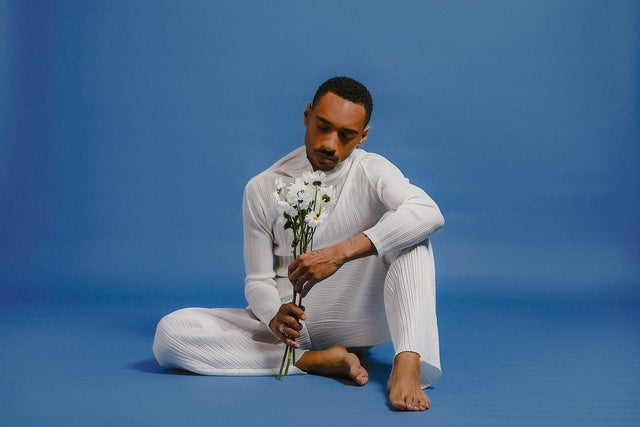
DR: Utah isn’t always seen as a Black cultural space. Any hesitation?
DB: No, none at all. One of my closest friends was born and raised in Utah, and one of his siblings is working on the committee. It’s going to be almost like an additional family reunion.
I’ve been to Salt Lake City before. If I’m not mistaken, Badu did a gig there. It was a concert in the park series. She was on stage for two hours. You’d have thought those tickets were $100, but they were five bucks. I was like, “That’s tight.”
DR: Michelda , how do you define success for this event?
MC: I don’t have an answer outside of — as long as attendees ask me to do it again, that’s success.
I’ve stood by a lot of metrics in my life, working in corporate America since I was 18. I’m sick of the word “metrics” — stats, statistics, “circling back.” I’m done with that. I’m decolonizing my way of thinking about purpose.
We want to be self-sustaining, especially because of the political climate. I’m glad we took the leap to create something that can become a nonprofit that’s self-sustaining — so we don’t have to beg people who are non-Black, who don’t understand our needs, to support what we want to do for our community.
That would be success for me — if this event was successful enough to allow us to continue to do it year after year. Honestly, I can’t wait for the day — seeing people’s faces, the joy. I like to go around and talk to people. “How are you doing? Do you need water? Where did you come from?” We say, “Hey, neighbor,” because we want them to feel comfortable. I just want to see people happy. That’s it.
DR: Durand, do you approach spaces like this differently?
DB: A gentleman came up to me after my first London Pride — where I shared the stage with Chaka Khan — and said, “You being yourself up there was such a statement, because it takes a lot for us to be ourselves and find our identity and be confident in that.”
I could tell by some of the looks on people’s faces they were processing what they were witnessing — in a good way. It makes me think, yes, this is necessary. I have to show up as myself.
I know how to read the room. There are different levels to how we show up, but I’m always going to be myself at the core. As long as people feel that I’ve done my job.
